


- Under the guise of developments, innovations, inventions, and growth in the technology-driven modern-day world, we need to preserve some of those time-tested methodologies that have worked wonders for humanity for millennia. Agreed, anachronistic practices/beliefs should not find any place since we must move on in life. Adapting to the altered existence is the key to survival. As the popular saying goes, the only constant in life is change, and we must be geared up towards embracing the same despite encountering initial hiccups/challenges. Of course, it’s a common human recourse to avoid wholeheartedly embracing the new inventions. However, the fact of the matter is, we do not have a choice either. Or else, we will be left far behind, you see.

PC: Freepik
- As you know, this is a digital age where everything is driven by the revolutionary internet that has penetrated so deeply into our day-to-day lives that we have become almost completely dependent on the medium. Nonetheless, certain things still should be pursued conventionally without allowing the digitalization in an overwhelming manner. Take, for instance, how traditional newspaper reading should be encouraged despite the numerous digital instruments/media available for this purpose. Reflect on how we can read this article, thanks to a unique brain circuit our ancestors evolved about 6,000 years ago. Unfortunately, that circuit is weakening species-wide because we don’t use it enough of late.

PC: WGBH
- Let’s look at some of the statistics made available. In the US, daily reading for pleasure has declined 40% in 20 years. In the UK, reading among 8-18-year-olds has halved. School librarians will tell us the situation is dire in India as well. So, it’s heartening that the Uttar Pradesh government has made newspaper reading mandatory in its schools. Every day, students will take turns to read aloud the main points of news and editorials from a selection of English and Hindi papers. The government hopes this will improve their GK, vocabulary, writing skills, and critical thinking. It should, because reading not only pours information into the mind but also catalyzes its organization into conceptual models.
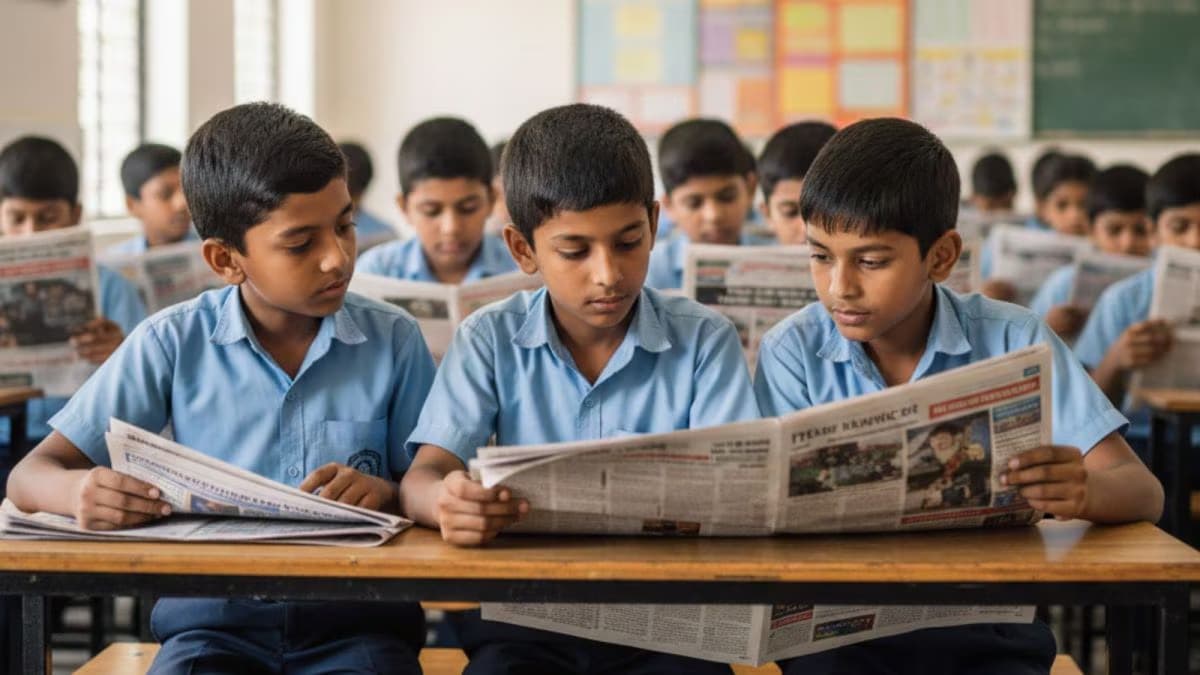
PC: Education Post News
- Mind you, videos and podcasts aren’t as effective because we can’t linger over their words, nor turn pages for reference. And the printed page doesn’t vibrate with notifications and other distractions. When we give up slow, deliberate reading for reading’s sake, and stick the hose of fast digital content in our ears, our abilities to analyse critically and draw inferences weaken. So, well begun, UP, and now all states should do more. Going beyond the daily 10-minute mandate, encourage children to become bookworms. Help them find focus, which is key to future success. Investing in libraries is a public good. The governments, educators, academicians, teachers, parents, and students should diligently pursue this conventional reading habit.