

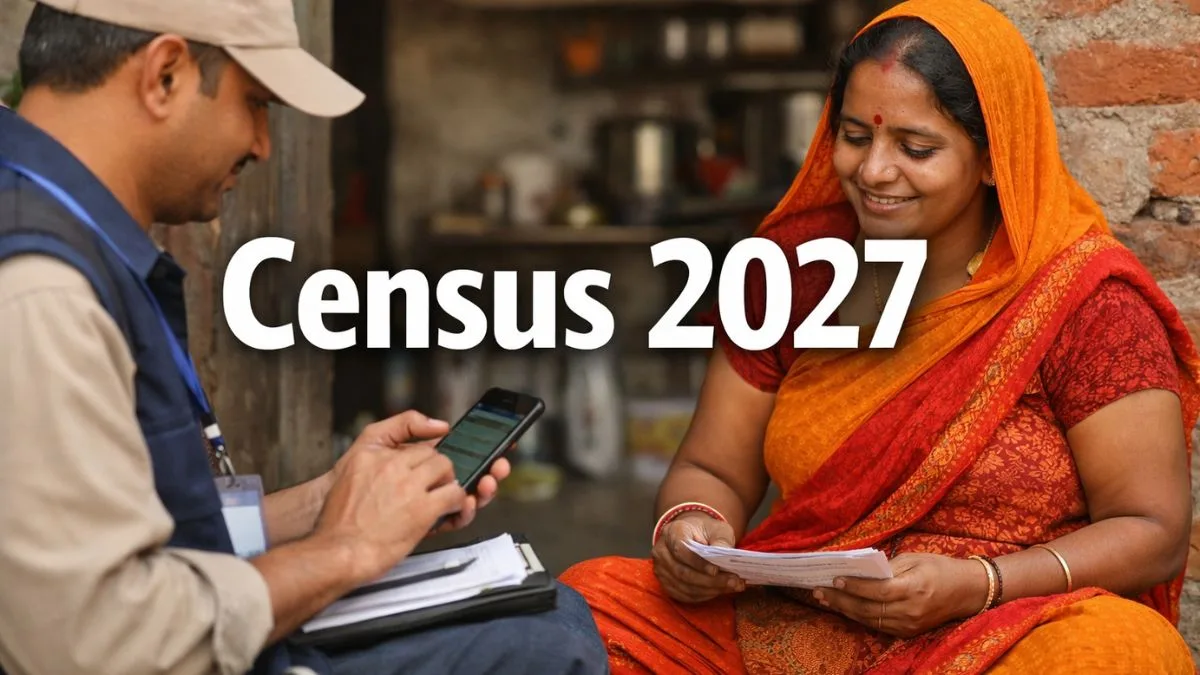
- The much-delayed Census in India has kicked off to capture the population count of the citizens, which could be used for various purposes, including the delimitation exercise to reassign the parliamentary seats for the Lok Sabha elections. As we are aware, the Election Commission of India (ECI) has been conducting special intensive revision (SIR) in some states over the last year or so, coinciding with the state assembly elections there. Thus, the first phase of India’s 16thNational Census from 01st April to 30th September 2026, with a focus on digital, app-based data collection. The population enumeration phase will follow in February 2027, featuring the first nationwide caste enumeration since 1931 and a self-enumeration option.

PC: Sanskriti IAS
- However, one of the provisions enunciated in the Census 2027 has caused a tremendous amount of discontentment among the concerned citizens, which mentions recording live-in couples as married. This provision defeats the purpose of capturing social changes on expected lines and objectively. A question arises if a government doesn’t measure x, does x not exist? Furthermore, what are the implications of the government refusing to measure x? Census 2027 will be recording live-in couples, who are staying in a household in a stable union, as married couples. This means that 0 data on how many Indians are choosing live-in relationships will continue to be 0. Such wilful unseeing, obviously, enfeebles the Census.
PC: India Briefing
- Unquestionably, it should be capturing cultural shifts, instead of rubbing out their existence. Remember, such eraser acts can’t kill any cultural momentum. What they obstruct, instead, is policymakers’ ability to constructively address how a society is transforming. The US census shows that, among those ages 18-24, live-ins are now more popular than marriage. The UK census shows the proportion of people who live as a cohabiting couple is up to 24%. Nobody is making the case that the phenomenon is as pervasive in India. What we are certain of, though, is that it exists, it’s growing, and not just in metro cities. This much, journalists can find out and report. Nonetheless, a comprehensive enumeration, only a census can do, you see.
PC: News Arena
- To place in the right context, there are countless reasons Indians have become interested in live-in relationships. Consider, in no particular order of importance, how expensive weddings are, how a more equal kind of love can need a more equal kind of partnership, how this relationship vibes like an intentional daily choice, rather than an obligatory social contract, how it can feel freer. One can’t also discount the fact that it can also, of course, draw a lot of social animus. Never mind that the SC has found it protected under the right to life and liberty. Hostilities are animated by the idea that this is not Indian culture. But culture never is, never has been, a static thing. It’s constantly changing. Once upon a time, we were much less puritanical. Indian mythology suggests.